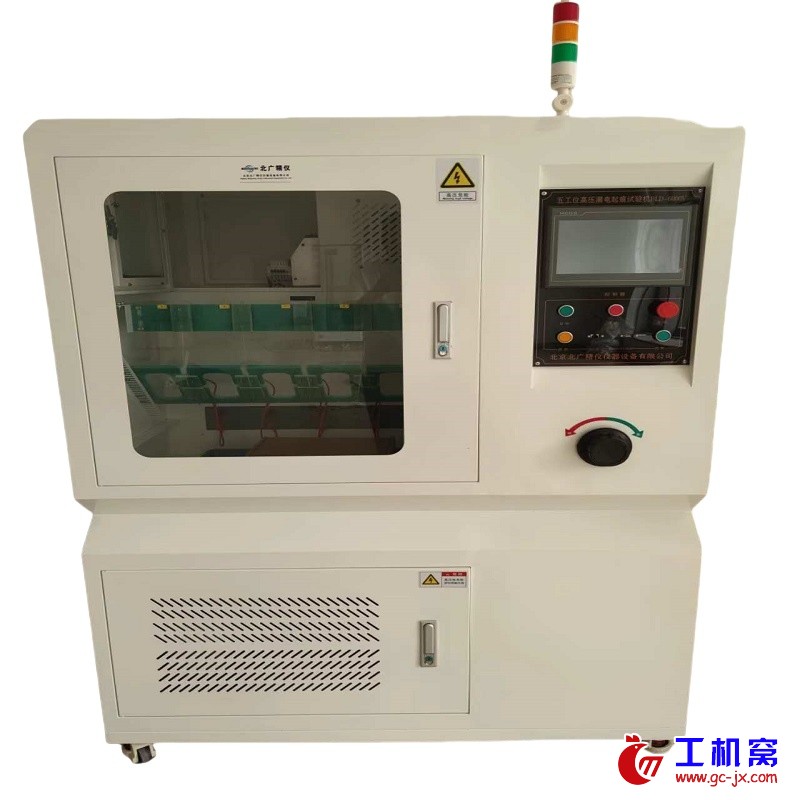


1. 定义与核心用途
高压耐电痕化和蚀损试验仪是用于评估电气绝缘材料在潮湿含杂质环境下耐高压性能的设备,通过模拟工频(45-65Hz)条件下的液体污染物泄漏场景,测试材料表面因放电形成的导电通道(电痕化)及材料损耗(蚀损)程度。其核心应用包括:
l电工电子产品:如继电器插座、转换开关盖等绝缘部件的质量检测。
l家用电器:评估绝缘材料在潮湿环境下的长期稳定性。
l新兴领域:电动汽车高压快充系统(600V以上)的绝缘材料耐压测试。
2. 技术参数与测试标准
l电压范围:100V~6.0KV±5%可调,支持交直流切换。
l控制精度:采用西门子PLC和高精度蠕动泵,滴液≤0.5%。
l安全保护:电流≥60mA持续2秒自动切断,配备门开关联锁和排风系统。
l符合标准:
GB/T6553-2024(新标准,等同IEC60587:2022)
ASTM D2303-2003(美国材料试验标准)。
3. 操作流程与注意事项
l试验步骤:
1.将试样倾斜安装(通常30°角),滴液管以30±5秒间隔滴落污染液。
2.逐步升压至设定值(如2.5KV),持续观察电痕形成。
3.记录电流变化,达到60mA阈值时终止试验。
l关键注意事项:
环境控制:温度20-25℃,湿度≤60%,避免电磁干扰。
设备维护:每月检查漏电保护器,污染液槽需用316不锈钢材质防腐蚀。
4. 应用领域与行业标准演进
l重点行业:
电力设备:绝缘子伞套在盐雾环境下的蚀损测试。
新能源汽车:高压电池包绝缘材料的耐电痕化验证。
l标准更新:
GB/T6553-2024新增逐级升压法,更严苛模拟实际工况。
要求设备具备高压真空切断技术,提升测试安全性。
The high-voltage tracking and erosion tester is a device used to evaluate the high-voltage resistance of electrical insulation materials in a humid and impurity-containing environment. By simulating liquid contaminant leakage scenarios under power frequency (45-65Hz) conditions, it tests the conductive paths (tracking) formed on the material surface due to discharge and the degree of material loss (erosion). Its core applications include:
Electrical and electronic products: Quality inspection of insulating components such as relay sockets, switch covers, etc.
Household appliances: Evaluate the long-term stability of insulating materials in humid environments.
Emerging field: Dielectric withstand voltage testing of insulating materials for high-voltage fast-charging systems (above 600V) in electric vehicles.
2. Technical parameters and testing standards
Voltage range: adjustable from 100V to 6.0KV±5%, supports AC/DC switching.
Control accuracy: Utilizing Siemens PLC and high-precision peristaltic pump, with a dripping accuracy of ≤0.5%.
Safety protection: The current is automatically cut off if it is ≥60mA for 2 seconds, and it is equipped with door switch interlock and exhaust system.
Conform to standards:
GB/T6553-2024 (new standard, equivalent to IEC60587:2022)
ASTM D2303-2003 (American Society for Testing and Materials Standard).
3. Operational procedures and precautions
Test steps:
1. Install the sample at an angle (usually 30°), and allow the dropper to dispense the contaminating solution at intervals of 30±5 seconds.
2. Gradually increase the voltage to the set value (such as 2.5KV) and continuously observe the formation of electrical tracking.
3. Record the current variation and terminate the test when it reaches the threshold of 60mA.
Key precautions:
Environmental control: Temperature 20-25℃, humidity ≤60%, avoid electromagnetic interference.
Equipment maintenance: Check the leakage protector monthly, and the contaminated liquid tank needs to be made of 316 stainless steel for corrosion resistance.
4. Application fields and industry standard evolution
Key industries:
Power equipment: Corrosion test of insulator sheds in salt spray environment.
New energy vehicles: verification of the electrical tracking resistance of insulation materials for high-voltage battery packs.
Standard update:
GB/T6553-2024 introduces a new step-by-step voltage boosting method to simulate actual working conditions more rigorously.
The equipment is required to be equipped with high-pressure vacuum cutoff technology to enhance testing safety.
一、不同型号设备的调整方法
触摸屏智能型(如BLD-6000V)
操作流程:
进入主界面选择"测试参数"菜单
选择"升压模式"(恒定/逐级)
在"升压速率"栏输入目标值(如0.5kV/min)
确认保存后返回主界面启动试验
基础旋钮型
组合操作:
长按"电压+时间"键3秒进入设置模式
旋转"电压调节"旋钮至目标速率(需对照刻度表)
短按"确认"键保存设置
工业编程型
PC端控制:
通过专用软件设置升压曲线(支持0.1kV/min步进调节)
可存储多组预设参数,支持自动升压序列
二、标准验证与校准
示波器验证法
连接高压示波器至测试回路
观察升压曲线需满足:
初始斜率≤0.5kV/min
全程波动范围±5%以内
达到设定电压后保持稳定
替代校准法
使用标准电阻替代试样
测量实际升压时间与理论值偏差
若偏差>5%需重新调整PLC参数
三、安全注意事项
固件升级:旧设备需升级至支持GB/T6553-2024的固件版本
联锁保护:升压过程中电流≥60mA必须自动切断(不可关闭此功能)
环境要求:温度20-25℃、湿度≤60%时校准结果准确

高压耐电痕化和蚀损试验仪升压速率调整后校准要求详解
一、校准必要性分析
1.标准强制要求
2.根据GB/T6553-2024/IEC60587:2022标准,升压速率调整后必须进行校准,以确保测试精度符合±5%的范围。新标准特别强调逐级升压法(0.5kV/min)的精确控制,未经校准可能导致测试结果无效。
3.设备性能验证
4.升压速率直接影响电痕化测试的重复性。调整后需验证:
l初始阶段无电压突跳
l全程速率波动≤±5%
l达到设定值后稳定保持。
二、校准方法与步骤
1.示波器验证法(推荐)
l连接高压示波器至测试回路
l观察升压曲线需满足:
初始斜率≤0.5kV/min
全程波动范围±5%以内
达到设定电压后保持稳定。
2.替代校准法
l使用标准电阻替代试样
l测量实际升压时间与理论值偏差
l若偏差>5%需重新调整PLC参数。
三、校准频率建议
1.常规周期
l每季度全面校准一次(含升压速率、电极间距、滴液系统)
l设备维修或参数调整后必须立即校准。
2.特殊场景
l高湿度环境(>60%RH)使用后需增加校准频次
l连续测试超过50次建议中间校准。
四、关键注意事项
1.环境控制
l温度20-25℃、湿度≤60%时校准结果准确
l避免电磁干扰和振动。
2.安全规范
l校准前确认门联锁正常
l电流≥60mA自动切断功能不可关闭
l操作人员需佩戴绝缘手套。
3.记录要求
l保存校准前后的升压曲线数据
l记录校准日期、操作人员及环境参数。
聚合物绝缘材料漏电起痕试验仪详解
一、定义与用途
漏电起痕试验仪是专用于评估固体绝缘材料(如聚合物)在潮湿或污染环境下电气耐受能力的专业设备,通过模拟电场与电解液联合作用下的漏电起痕现象,测定材料的相比电痕化指数(CTI)和耐电痕化指数(PTI)。主要应用包括:
电气安全检测:用于照明设备、低压电器、家用电器、电机等产品的绝缘材料性能验证,防止因漏电引发火灾或短路事故。
材料研发:筛选耐漏电性能优异的聚合物材料,如工程塑料、电气连接件等,提升产品可靠性。
行业标准符合性:满足GB4207、IEC60112、UL746A等国际和国家标准要求,是强制认证的关键测试设备。
二、技术参数与测量原理
核心参数
电压范围:高600V(交流/直流),覆盖常见绝缘材料测试需求。
电极配置:铂金电极(纯度99%),尺寸2mm×5mm×40mm,间距4.0mm±0.01mm,压力1.00N±0.01N。
试液要求:0.1%NH₄Cl溶液(电阻率3.95±0.05Ωm),滴液间隔30秒±0.1秒。
测量原理
模拟环境:在材料表面施加电压,定时滴加导电液体,观察是否形成碳化导电通道(即漏电起痕)。
判定标准:记录材料在特定电压下耐受的液滴数,CTI值越高表明材料耐漏电性能越强。
三、选购建议
明确测试需求:
若需高精度(如科研),选择带触摸屏和自动数据记录的型号(如LD-H)。
若预算有限,可考虑基础款(如PY-LDQH),但需确保符合GB4207标准。
验证设备资质:确认厂商提供校准证书及技术支持,优先选择铂电极纯度达标的设备。
扩展功能:如需多场景测试,可选购集成灼热丝、针焰试验的多功能机型。
如需进一步了解具体型号的操作或采购渠道,可提供更详细的应用场景需求。
1. Adjustment methods for different types of equipment
Touch screen intelligent type (such as BLD-6000V)
Operational procedure:
Enter the main interface and select the "Test Parameters" menu
Select "Boost Mode" (Constant/Step-by-Step)
Input the target value (such as 0.5kV/min) in the "Boost Rate" column
After confirming and saving, return to the main interface to start the test
Basic rotary knob type
Combination operation:
Long press the "Voltage + Time" button for 3 seconds to enter the setting mode
Turn the "Voltage Adjustment" knob to the target speed (refer to the scale)
Press the "Confirm" button briefly to save the settings
Industrial programming type
PC control:
Set the boost curve through dedicated software (supporting step adjustment of 0.1kV/min)
It can store multiple sets of preset parameters and supports automatic boost sequences
II. Standard verification and calibration
Oscilloscope verification method
Connect the high-voltage oscilloscope to the test circuit
Observing the pressure rise curve requires the following conditions to be met:
Initial slope ≤ 0.5 kV/min
The fluctuation range throughout the entire process is within ±5%
Remain stable after reaching the set voltage
Alternative calibration method
Use a standard resistor to replace the test sample
Measure the deviation between the actual boost time and the theoretical value
If the deviation exceeds 5%, the PLC parameters need to be readjusted
III. Safety precautions
Firmware upgrade: Old devices need to be upgraded to a firmware version that supports GB/T6553-2024
Interlock protection: During the boost process, the current must be automatically cut off when it reaches or exceeds 60mA (this function cannot be disabled)
Environmental requirements: The calibration results are accurate when the temperature is between 20-25℃ and the humidity is ≤60%
Detailed explanation of calibration requirements after adjusting the voltage rise rate of the high-voltage tracking and erosion resistance tester
I. Analysis of the necessity of calibration
1. Mandatory requirements of standards
2. According to the GB/T6553-2024/IEC60587:2022 standard, calibration must be performed after adjusting the voltage rise rate to ensure that the test accuracy is within the range of ±5%. The new standard places special emphasis on precise control of the stepwise voltage rise method (0.5kV/min), and failure to calibrate may result in invalid test results.
3. Equipment performance verification
4. The rate of voltage increase directly affects the repeatability of the tracking test. After adjustment, verification is required:
No voltage jump in the initial stage
The fluctuation in the overall speed is ≤±5%
Stabilize and maintain after reaching the set value.
II. Calibration Methods and Procedures
1. Oscilloscope verification method (recommended)
Connect the high-voltage oscilloscope to the test circuit
Observing the pressure rise curve requires the following conditions to be met:
Initial slope ≤ 0.5 kV/min
The fluctuation range throughout the entire process is within ±5%
Remain stable after reaching the set voltage.
2. Alternative calibration method
Use a standard resistor to replace the test sample
Measure the deviation between the actual boost time and the theoretical value
If the deviation is greater than 5%, the PLC parameters need to be readjusted.
III. Recommended calibration frequency
1. Regular cycle
Conduct a comprehensive calibration every quarter, including the rate of pressure rise, electrode spacing, and liquid dripping system
Calibration must be performed immediately after equipment maintenance or parameter adjustment.
2. Special scenarios
The calibration frequency needs to be increased after use in high humidity environments (>60%RH)
It is recommended to perform intermediate calibration after more than 50 consecutive tests.
IV. Key precautions
1. Environmental control
The calibration result is accurate when the temperature is between 20-25℃ and the humidity is less than or equal to 60%
Avoid electromagnetic interference and vibration.
2. Safety specifications
Confirm that the door interlock is normal before calibration
The automatic shut-off function when the current is ≥60mA cannot be disabled
Operators need to wear insulating gloves.
3. Recording requirements
Save the boost curve data before and after calibration
Record the calibration date, operator, and environmental parameters.
Detailed explanation of the tracking tester for polymer insulation materials
1. Definition and purpose
The tracking tester is a specialized device designed to evaluate the electrical endurance of solid insulating materials (such as polymers) in humid or contaminated environments. By simulating the tracking phenomenon under the combined action of an electric field and an electrolyte, it measures the comparative tracking index (CTI) and proof tracking index (PTI) of the material. Its main applications include:
Electrical safety testing: used for verifying the performance of insulating materials in lighting equipment, low-voltage electrical appliances, household appliances, motors, and other products, to prevent fires or short-circuit accidents caused by electric leakage.
Material research and development: Screening polymer materials with excellent leakage resistance, such as engineering plastics and electrical connectors, to enhance product reliability.
Industry standard compliance: meeting the requirements of international and national standards such as GB4207, IEC60112, and UL746A, it is a key testing equipment for compulsory certification.
II. Technical Parameters and Measurement Principles
Core parameters
Voltage range: up to 600V (AC/DC), covering the testing needs of common insulation materials.
Electrode configuration: platinum electrode (purity 99%), dimensions 2mm×5mm×40mm, spacing 4.0mm±0.01mm, pressure 1.00N±0.01N.
Test solution requirements: 0.1% NH₄Cl solution (resistivity 3.95±0.05Ωm), with a drop interval of 30 seconds ± 0.1 seconds.
Measuring principle
Simulation environment: Apply voltage to the material surface and regularly add conductive liquid, observing whether a carbonized conductive pathway forms (i.e., tracking).
Judgment criteria: Record the number of droplets the material can withstand under a specific voltage. A higher CTI value indicates stronger electrical leakage resistance of the material.
III. Purchase Suggestions
Clarify testing requirements:
If high precision is required (such as for scientific research), choose a model with a touch screen and automatic data recording (such as LD-H).
If the budget is limited, one may consider the basic model (such as PY-LDQH), but it must be ensured that it meets the GB4207 standard.
Verify equipment qualifications: Confirm that the manufacturer provides calibration certificates and technical support, and give priority to equipment with platinum electrodes of acceptable purity.
Extended functions: For multi-scenario testing, you can opt for a multifunctional model that integrates a glow wire and needle flame test.
If you need further information about the operation or procurement channels of specific models, please provide more detailed application scenario requirements.